01On board
Sense
Digital sensors live on the structure — strain, vibration, corrosion, temperature, motion. The body is wired, permanently.
Continuous vitalsDigital Healthcare Engineering
AETHERION gives ships and offshore structures lifetime digital healthcare — continuous monitoring, accurate diagnosis and timely intervention, from sensors at sea to decisions on shore, long before failure.
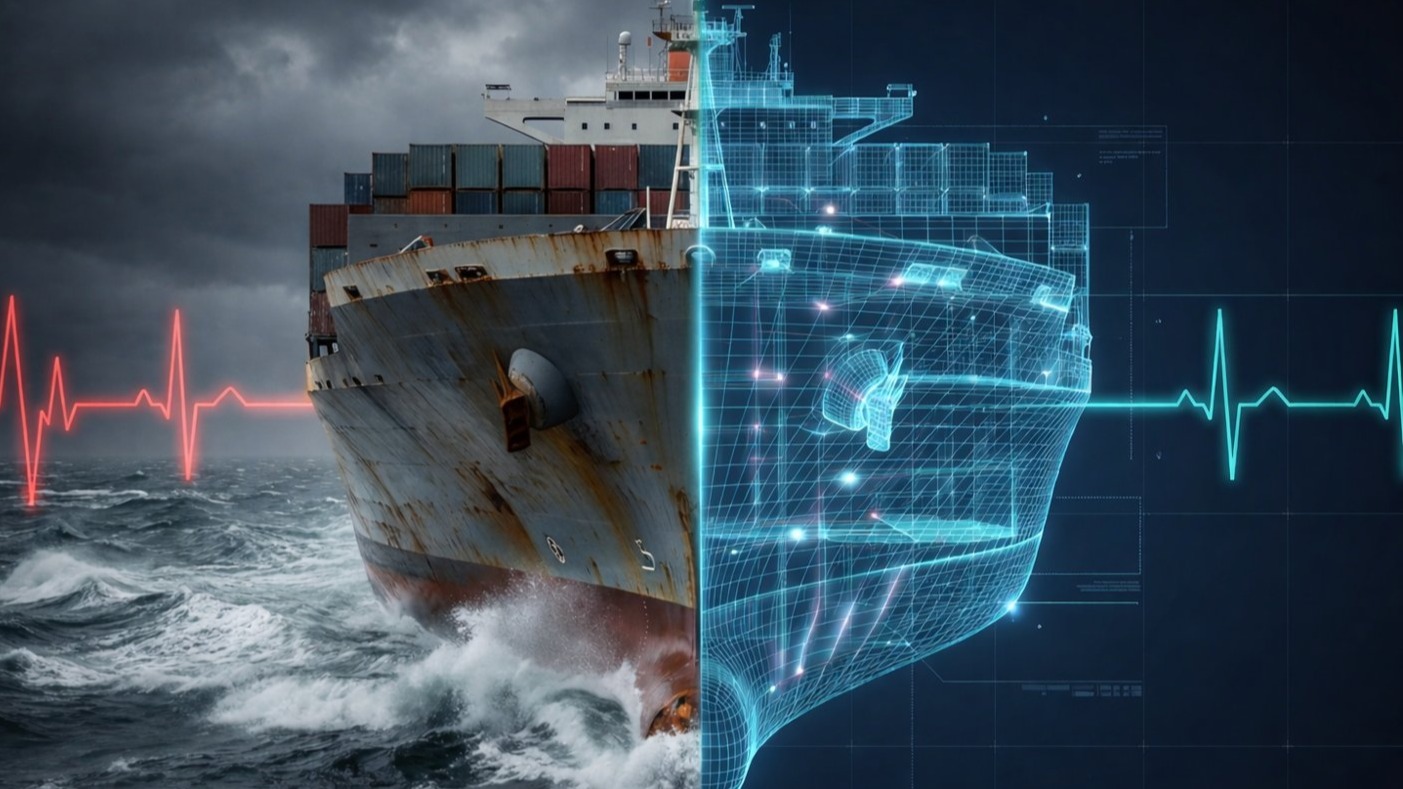
The concept
Modern medicine keeps people alive through continuous observation, early diagnosis and timely treatment. Digital Healthcare Engineering applies the same discipline to steel — across the entire life of a structure, not just at scheduled check-ups.
Heart rate, blood pressure, temperature — sampled continuously, not annually.
Strain, vibration, corrosion, temperature and motion — measured on the structure, at sea, around the clock.
Symptoms are observed, tested and given a name.
Anomalies are detected, located and identified: crack, dent, corrosion — the moment they begin.
How the condition will develop if nothing is done.
Physics and AI project damage growth and the time left before limit states are reached.
The right procedure, at the right moment — not too late, not too often.
Maintenance planned and executed before failure — in the right port, with the right parts.
The challenge
Ships and offshore structures age in silence — corrosion thins plate, fatigue grows cracks, storms leave dents. Inspections are periodic; degradation is not. Failures still take operators by surprise, and surprise at sea is expensive.
Plate thickness quietly lost year after year, between dry-dockings — invisible until a gauge, or a leak, finds it.
Millions of wave cycles concentrate at welds and details. Cracks initiate long before anyone is scheduled to look.
Storms, slamming, collisions and groundings leave damage that needs assessment now — not at the next survey.
Periodic inspection sees a structure a few days per decade. AETHERION watches it every second of its life.
The system
Live demonstration
A simplified view of an AETHERION digital twin. Inject a damage event and watch the system detect, diagnose and respond — the full loop, compressed into seconds.
Applications
The same framework — sense, diagnose, predict, intervene — adapted to every structure that lives at sea.
Containers, tankers, bulkers — hulls that only earn when they sail, and only sail when they're healthy.
Availability is the mission. Structural health is readiness, measured in real time.
Fixed and floating, decades on station — where a surprise is never a small problem.
Production never wants to stop. Neither does the monitoring that keeps it safe.
Hundreds of towers, one control room — fleet healthcare at the scale of a wind farm.
Out of sight is no longer out of reach. The seabed reports in, too.
Origin
Digital Healthcare Engineering didn't start as a product pitch. It began as a research framework — and grew into one.
Digital Healthcare Engineering is articulated as a new discipline: lifetime healthcare for engineering structures, by direct analogy with modern medicine — monitor, diagnose, predict, intervene.
Methods for in-service monitoring, damage diagnosis, prognosis and intervention planning are developed and published across multiple structure classes.
Journal special issues, international collaboration and academia–industry projects carry DHE from concept toward practice, structure class by structure class.
The framework becomes a product: one platform for the lifetime healthcare of ships and offshore structures — sensors, twin, diagnosis and decisions in a single loop.
Research
Peer-reviewed publications behind the framework
View the full publication list ↗Begin
Tell us about your structures. We'll show you what lifetime digital healthcare looks like for them — from first sensor to first avoided failure.
Start the diagnosis →